“Isn’t jump training hard on your knees?”
It’s the most common pushback we hear when we bring up power training for anyone over 40. And it makes sense, most people picture box jumps and sprinting drills, not something built for someone managing a cranky knee or an old back injury.
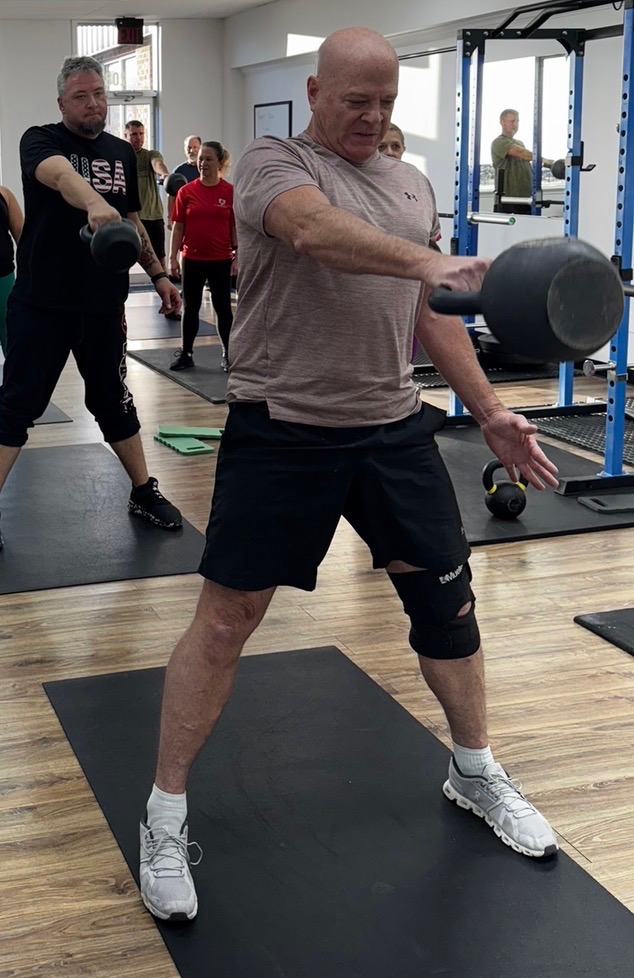
Here’s the thing: you don’t need to jump to train power. The kettlebell swing does the same job, and it might be the single best tool for this age group to do it safely.
Power is the first thing you lose as you age, and most training programs never touch it.
Strength and power are not the same thing. Power is how fast you can produce force, and it starts declining in your 30s, often years before raw strength drops off. It’s why catching yourself before a stumble gets harder, or why standing up quickly from the couch feels different than it used to. Most adult fitness programs are entirely slow and controlled: squats, presses, steady cardio. That work matters, but it never trains your body to produce force quickly. The kettlebell swing fills that exact gap.
The swing trains explosive power through your hips, not your knees.
A kettlebell swing is a hip-hinge movement. The power comes from snapping your hips forward, not from your knees absorbing impact off the ground the way a jump does. That’s the key difference. You get the same fast, explosive force production that plyometrics are known for, without any landing impact on your joints. For someone managing knee issues or worried about impact, this is often the safest entry point into power training available.
It builds the exact muscles that keep you upright as you age.
The posterior chain, your glutes, hamstrings, and lower back, is what the swing trains hardest. That’s also the muscle group most responsible for catching you when you trip, keeping your posture upright through the day, and protecting your lower back from strain. Strong, powerful hips are one of the best predictors of staying mobile and injury-free later in life.
It’s low-skill to learn safely, and scales easily.
Unlike a box jump or a sprint, the swing can be taught, scaled, and regressed easily. Lighter bells, fewer reps, slower tempo, all of it lets someone new to this kind of training build the pattern safely before adding intensity. Progression happens through load and speed, not through increasing impact on your joints. That makes it one of the more forgiving ways to introduce real power work to a body that hasn’t done anything explosive in years.
What this actually looks like in practice.
Sessions start with hip hinge mechanics and a light bell, building the pattern before adding weight or speed. From there, load and pace increase gradually based on how the body responds, not a fixed number on a page. It’s simple, but it’s not the same as “easy,” done right, the swing is one of the more demanding things you’ll do in a session.
Want to feel this for yourself?
Our 28 Fall Challenge is built around kettlebell training like this, safe, scalable power work that protects your joints instead of pounding on them.
Reply to this message and let us know you want the details, we’ll get you everything you need.
— Forest and the FVT Team